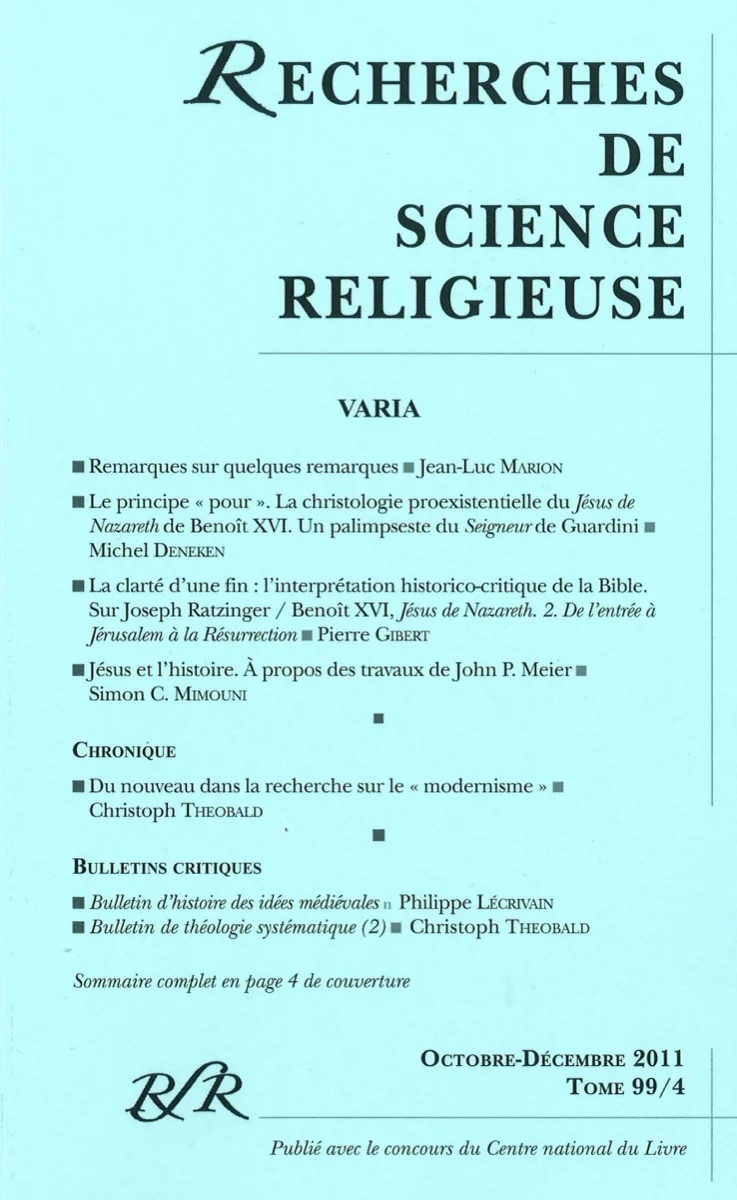
La clarté d’une fin : l’interprétation historico-critique de la Bible
Sur Joseph Ratzinger / Benoît XVI, Jésus de Nazareth, 2. De l’entrée à Jérusalem à la Résurrection
Pierre GIBERT
Si, par rapport à l’avant-propos du premier tome (cf. l’article du même auteur sur ce tome dans RSR 96/2 [2008], 219-240), on doit prendre acte d’une plus grande rigueur de vocabulaire dans ce second tome, la lecture de l’avant-propos oblige encore à revenir sur ce qui avait provoqué un certain malaise : une conception par trop étroite de ce qu’il faut rigoureusement désigner soit comme « approche critique », ou « approche historico-critique », « critique » ou « recherche historico-critique », ou « exégèse critique ».Dans ce second tome, J. Ratzinger / Benoît XVI affirme un peu trop vite que « l’interprétation historico-critique a donné tout ce qu’elle avait à donner » et offre un propos quelque peu simplificateur lorsqu’il considère le travail de l’exégèse de notre époque en le taxant non seulement d’« herméneutique positiviste », mais aussi de « devenir théologiquement insignifiant ».
Compared with the preface to the first volume (cf. the author’s article on this volume in RSR 96/2 [2008], 219-240), we must recognize there is a greater rigour in the use of vocabulary in this second volume. Nonetheless, the preface of the second book likewise necessitates careful examination of what gave rise to a certain uneasiness with the first : too narrow a conception of what should properly be termed a ‘critical approach’ or ‘historic-critical approach’, ‘critical’ or ‘historico-critical research’ or ‘critical exegesis’. In this second volume, J. Ratzinger / Benedict XVI affirms somewhat too quickly that ‘historico-critical interpretation has given us all it has to give’ and proposes a rather too simplified portrait when he examines the work of exegesis in our time, taxing it not only with being ‘positivist hermeneutics’, but also of ‘becoming theologically insignificant’.
Sommaire
Bulletins critiques
ce numéro
à la revue