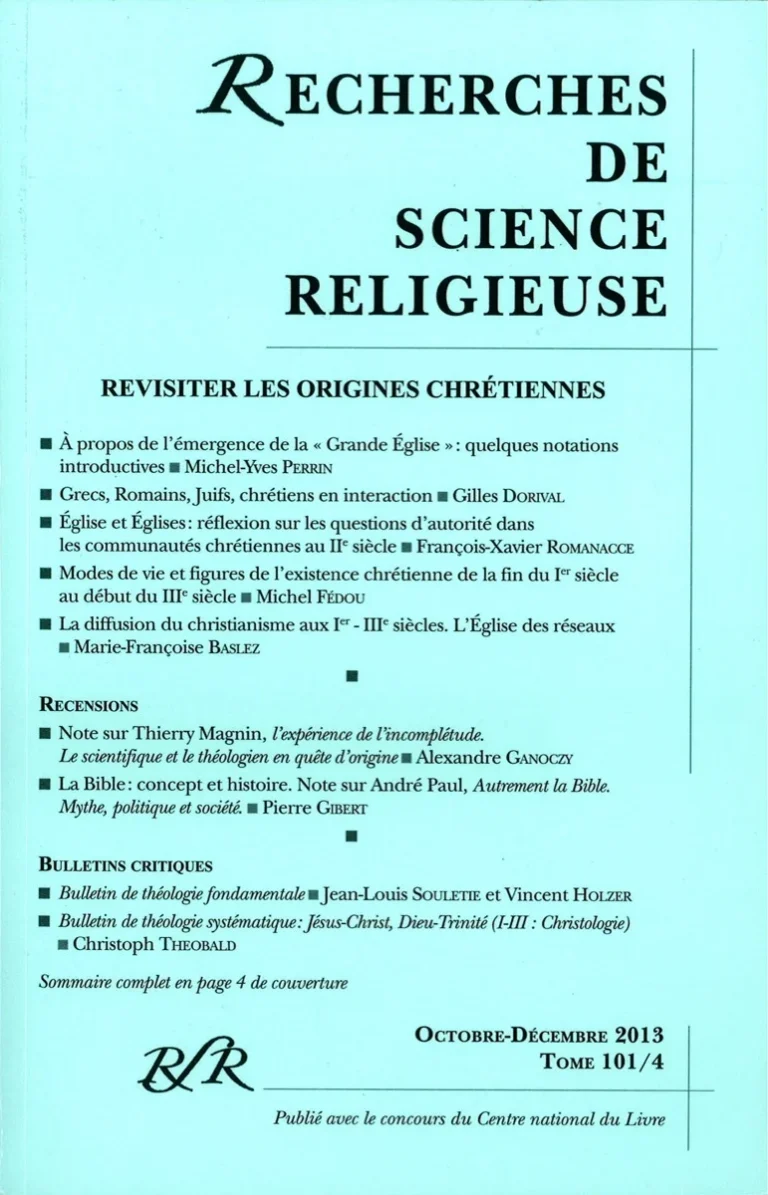
La diffusion du christianisme aux Ier – IIIe siècles
L’Église des réseaux
Marie-Françoise BASLEZ
L’histoire des réseaux, champ de recherche récent, apparaît opérante pour étudier la christianisation du fait de l’importance du phénomène associatif dans l’Antiquité. L’approche croisée des textes chrétiens et de la documentation extérieure (textes, inscriptions, papyrus, archéologie) met en évidence le rayonnement de pôles vers la périphérie. La mission apostolique a utilisé des réseaux préexistants d’hospitalité et de clientèle, mais se sont mis rapidement en place des réseaux spécifiquement chrétiens – hospitaliers, financiers, épistolaires – sur lesquels s’est construite l’unité de l’Église. Les évêques ont été des hommes de réseaux et ont fini par construire un réseau épiscopal. Cette évangélisation en interaction avec la société profane a créé une dynamique identitaire en obligeant les Églises à construire leurs marges.
The history of networks, a recent field of study, seems pertinent in examining Christianisation, due to the importance of the associative phenomenon in Antiquity. Analyzing both Christian texts and outside documents (texts, inscriptions, papyri, archaeology) attests to how developments in the major centres spread to the periphery. The apostolic mission utilised already existing networks of hospitality and supporters, although specific Christian networks were built up rapidly – for hospitality, finance, epistolary communication – on the basis of which the unity of the Church was constructed. Bishops were networkers and eventually put together an episcopal network. This evangelisation interacting with secular society created an identitary dynamics by obligating the Churches to construct their margins.
Sommaire
Michel-Yves PERRIN
François-Xavier ROMANACCE
Bulletins critiques
ce numéro
à la revue