La théologie de Moltmann en Chine : réception, dialogue et lectures comparatives
Li Haoyu, Naomi Thurston
La présente contribution introduit à la réception de Jürgen Moltmann en Chine en offrant d’abord une vue d’ensemble de la réception de sa théologie chez les érudits chinois contemporains. La seconde partie « Une comparaison de la doctrine de Dieu chez Y. T. Wu et Jürgen Moltmann » propose une mise en parallèle innovatrice entre Le Dieu crucifié de Moltmann et la pensée d’une figure séminale de l’histoire moderne de l’Église chinoise : Y. T. Wu (1895-1979), un penseur chrétien controversé et initiateur du Three-Self Patriotic Movement (TSPM) dans l’Église protestante chinoise. La doctrine de Dieu proposée par Wu, telle qu’elle est introduite dans son No One Hath Seen God (沒有人看見過上帝), de 1943, est comparée à la relecture radicale du Dieu chrétien mise en œuvre par Moltmann à travers son trinitarisme social et le Dieu souffrant, des notions qui sont importantes dans les théologies chrétiennes chinoises qui se sont traditionnellement concentrées sur la christologie, le salut national (chez les modernistes), la piété personnelle (chez les fondamentalistes) et la souffrance. La présente contribution étend la recherche existante sur Moltmann et la Chine et Moltmann en Chine à un troisième volet, en comparant sa théologie avec celle de penseurs chinois chrétiens et leurs œuvres.
The present contribution introduces Jürgen Moltmann’s reception in China by first presenting an overview of the reception of Moltmann’s theology in contemporary Chinese scholarship. The second part, “A Comparison of the Doctrine of God in Y. T. Wu and Jürgen Moltmann,” offers an innovative comparison between Moltmann’s Crucified God and the thought of a seminal figure in modern Chinese church history: Y. T. Wu (1895-1979), a controversial Christian thinker and initiator of the Three-Self Patriotic Movement (TSPM) in the Chinese Protestant Church. Wu’s doctrine of God, as introduced in his 1943 No One Hath Seen God (沒有人看見過上帝), is compared with Moltmann’s radical new reading of the Christian God through his understanding of social trinitarianism and the suffering God, notions that are meaningful in Chinese Christian theologies, which have traditionally focused on Christology, national salvation (for modernists), personal piety (fundamentalists), and suffering. This contribution extends existing research on Moltmann and China and Moltmann in China to a third strand, comparing Moltmann’s theology with Chinese Christian thinkers and their works.
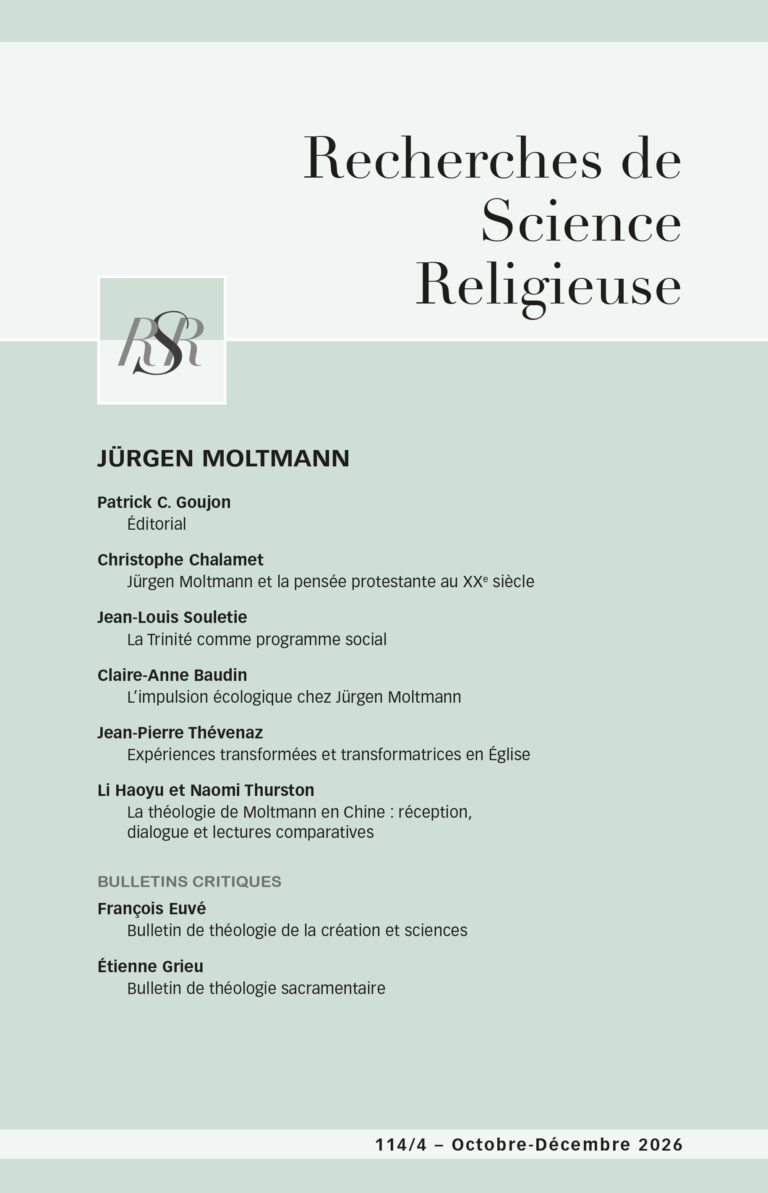
ce numéro
à la revue